

A mature tree can seem invincible, a permanent fixture on the property. But even the largest oaks and pines are living organisms susceptible to stress, disease, and decline. For homeowners across Marietta, Cobb County, and North Georgia, noticing a change in a prominent tree can be unsettling. Is it a temporary issue, or one of the first signs of a dying tree? Understanding the difference requires looking past the leaves and learning to read the subtle language of the entire tree.
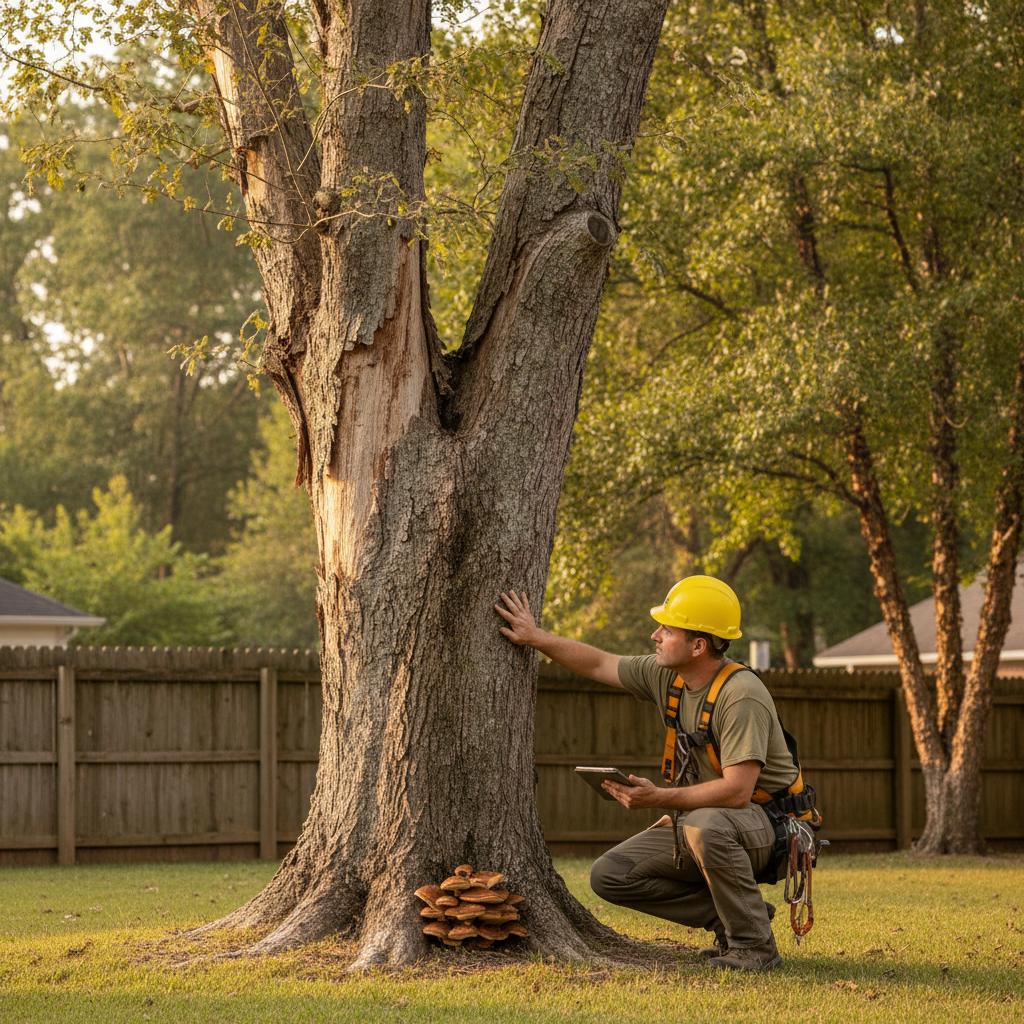
The most obvious indication of a tree's condition is its crown. A healthy deciduous tree should have a full canopy of leaves during the growing season, while a healthy evergreen should maintain consistent needle density. When this changes, it's one of the primary tree health warning signs. Homeowners should look for thinning foliage, where sunlight passes through much more easily than in previous years. This suggests the tree lacks the resources to support a full set of leaves.
Another major red flag is dieback, where the tips of branches are dead and leafless while the parts closer to the trunk are still alive. This often happens from the top down. If you see a concentration of dead, brittle branches in one section of the canopy, especially the upper crown, it signals a significant problem. The tree is essentially abandoning its extremities to conserve energy for its core.
Not all leaf or needle drop is cause for alarm. Deciduous trees lose their leaves in the fall, and pines shed older, interior needles annually. The key is context. If a maple's leaves turn yellow and drop in July, or a pine's outer needles turn brown en masse, it points to an underlying issue. A professional assessment can differentiate between normal seasonal changes and symptoms of stress or disease. A tree that is struggling will show these signs out of season or in a concentrated, unnatural pattern, unlike the uniform change of a healthy tree entering dormancy.
A tree's trunk is its circulatory system, and the bark is its protective skin. Damage here can be catastrophic. While some minor shedding is normal for species like sycamores or river birches, large patches of peeling or falling bark on an oak or maple are serious. This often exposes the smooth, bare wood underneath, indicating that a section of the tree is already dead. The tree is no longer transporting water and nutrients through that area.
Deep vertical cracks or seams in the trunk can also be problematic. They can be caused by everything from lightning strikes to internal decay. These openings become entry points for pests and moisture, accelerating rot. Perhaps the most definitive of all tree disease symptoms is the presence of fungal growth. The appearance of mushrooms, shelf fungi, or "conks" on the trunk or large branches is a clear sign of internal decay. The fungus you see is merely the fruiting body of a much larger organism consuming the wood from the inside out.
Many people see mushrooms at the base of a tree and think it's a minor, surface-level issue. In reality, it signals advanced internal rot. By the time a fungus produces a visible conk or mushroom, the internal decay process is often well-established. This compromises the tree's structural integrity long before the exterior shows significant signs of failure. A tree that looks mostly healthy on the outside can be dangerously hollow on the inside. This is why fungal growth is taken so seriously by ISA Certified Arborists during a risk assessment.
A tree's stability comes from its root system. Problems below ground often manifest in visible signs at the tree's base. Soil heaving or the appearance of newly exposed roots around the base can mean the tree is starting to uproot. This is a critical danger sign, especially if the tree has developed a noticeable lean. A proper sick tree diagnosis always involves inspecting the root flare — the area where the trunk widens as it meets the ground.
In Georgia, the dense clay soil presents unique challenges. While it holds water, it can also become compacted or waterlogged, suffocating roots and creating an ideal environment for root rot fungi. The presence of small, sprouting mushrooms in the soil all around the base of a tree can indicate a widespread root disease is attacking the tree from below.
Insider tip. Homeowners often see lichen or moss on tree bark and assume it's a harmful disease. In most cases, these organisms are harmless and simply use the bark as a surface to grow on. A real concern is the appearance of hard, woody shelf fungi (conks) or soft mushrooms, which directly indicate active decay within the wood itself.
The symptoms described above are rarely isolated. They are often caused by specific environmental pressures common to areas like Cartersville, Canton, and Sandy Springs. Prolonged periods of heat and drought stress can severely weaken a tree, making it vulnerable to secondary problems. An arborist can often tell when a tree is suffering from heat stress versus an insect infestation.
For pine trees in particular, the Southern Pine Beetle is a major threat. These insects bore into the bark, cutting off the tree's nutrient flow. The first sign is often small, popcorn-like clumps of resin, called pitch tubes, on the bark. Likewise, fungal diseases thrive in the humid Georgia climate, leading to root rot and cankers. Aable John's Tree Service, Inc., serving Marietta and Cobb County since 1985, has seen how these local factors impact the health of regional tree species.
The final determination of a tree's fate — whether it can be saved or must be removed — hinges on a professional assessment. A tree showing early signs of stress, like minor canopy thinning, might be saved with proper care, such as targeted tree fertilization or pruning. A tree with structural defects might be preserved using tree cabling or bracing to support weak limbs.
However, once a tree shows multiple advanced symptoms — major canopy dieback, large fungal conks, and a recent lean — it often transitions from a patient to a liability. These are the definitive signs of a dying tree that has lost its structural integrity. At this stage, the focus shifts from treatment to safe tree removal to protect people and property. Experts at Aable John's Tree Service, Inc., a Google Guaranteed company, use their extensive experience to conduct this crucial evaluation, backed by 5-star reviews on Google.
Expert insight. A single symptom, like a few dead branches, may not mean the tree is doomed. A professional arborist makes a diagnosis by looking at the combination and severity of all symptoms. A thinning canopy combined with fungal growth at the base and peeling bark paints a much more serious picture than any one of those signs alone. This complete view is what separates a guess from an accurate diagnosis. For a closer look at what that evaluation covers, see our tree health assessment guide.
Early identification of tree health issues is the best way to prevent a potential disaster. By learning to recognize the key warning signs in the canopy, trunk, and roots, property owners can take proactive steps. An informed eye can spot a problem while it's still manageable, allowing for interventions that can save a valuable tree or schedule a necessary removal before it fails unexpectedly. Learn more about our tree maintenance services to help keep your trees in optimal condition, or read our full tree risk assessment guide for a deeper look at how professionals evaluate hazard trees.
Worried about a tree on your property? Get a professional assessment before it becomes a hazard.
(770) 218-0068Free estimates — serving Marietta and Cobb County since 1985