

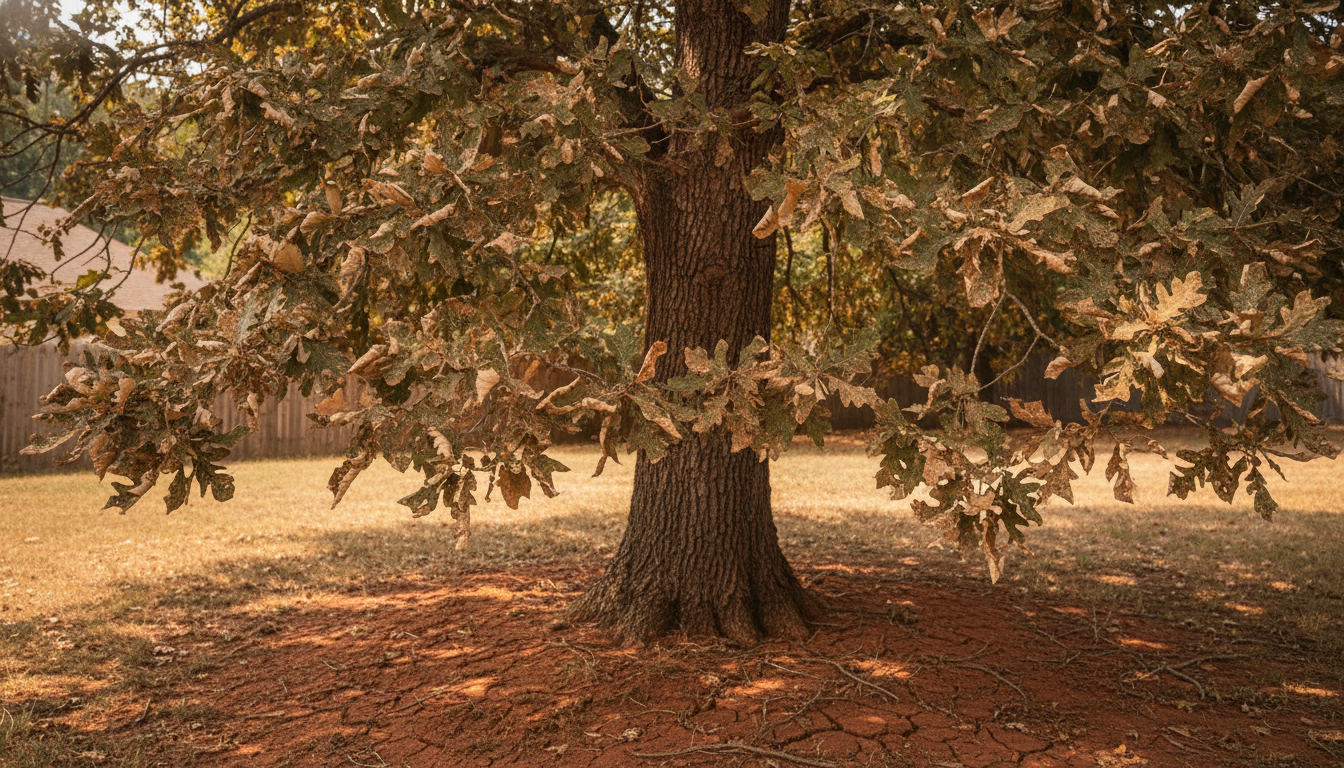
Georgia's summer heat is relentless, and it takes a toll on more than just the power bill. The trees that shade properties in communities from Marietta to Roswell face a significant battle against high temperatures and inconsistent rainfall. This is not a simple matter of a few brown leaves. Prolonged heat stress in trees can lead to irreversible decline, pest infestations, and eventual failure. The problem is compounded by the region's prevalent compacted red clay soil, which often sheds water rather than absorbing it, starving roots of the moisture they desperately need.
Understanding the early warning signs and implementing correct care techniques are critical for preserving the health and value of a property's mature trees. It requires moving beyond common assumptions about watering and recognizing that what works for a lawn does little for a 50-foot oak.
A tree under duress will almost always show visible signs, but they can be subtle at first. Homeowners often misinterpret these signals as seasonal changes or minor issues, when in fact they are cries for help. Ignoring them can be the difference between a tree that recovers and one that needs to be removed. Aable John's Tree Service, Inc. has observed these patterns across Cobb County for decades, noting that early detection is the most effective tool a property owner has.
The most obvious tree drought stress symptoms appear on the foliage. Leaves may begin to look scorched or sunburnt, particularly along the edges, a condition known as "leaf scorch." They might curl, wilt, or turn a sickly yellow-green color. Another clear indicator is premature leaf drop. If a deciduous tree starts shedding a significant number of leaves in July or August, it is a sign of severe stress. The tree is sacrificing its leaves to conserve water for the core trunk and root system. Wilting is another classic sign, especially when leaves remain droopy even in the cooler morning hours.
Some symptoms point to a more advanced state of distress. One of the most serious is the appearance of epicormic sprouts, also known as "suckers." These are small, leafy shoots that erupt from the main trunk or large branches. While they may look like new growth, they are actually a panic response. The tree is desperately trying to produce new foliage to photosynthesize after losing its primary canopy. This is a sign the tree's energy reserves are critically low and it is fighting for survival. A heat-stressed tree is also an open invitation for secondary invaders like borers, beetles, and fungal diseases that a healthy tree's immune system would normally fight off.
Providing effective tree care in Cobb County summer conditions requires a deep understanding of the local environment. National tree care advice often fails to account for the specific combination of intense heat, humidity, and challenging soil composition found in areas like Sandy Springs and Canton. This is where localized experience becomes invaluable.
Georgia's signature red clay is notoriously difficult for tree roots. When dry, it becomes hard and compacted, making it difficult for water to penetrate deeply. During a summer downpour, much of the water runs off the surface instead of soaking in to the root zone. This encourages shallow root growth, leaving trees vulnerable during dry spells. A tree with a shallow root system has no access to deeper, more stable moisture reserves and will show signs of stress much faster than one rooted in looser, loamier soil. Aable John's Tree Service, Inc.'s approach to tree care in Marietta always begins with an assessment of the soil condition around a tree.
Not all trees are created equal when it comes to heat. Native, established hardwoods like oaks, hickories, and maples generally have deep root systems that make them more resilient to drought once mature. However, many popular ornamental and understory trees struggle. Dogwoods, Japanese maples, and magnolias have shallower root systems and are much more susceptible to leaf scorch and heat stress. Knowing which trees on a property are most at risk helps prioritize watering and monitoring efforts during the hottest months.
The single most important factor in protecting trees from heat stress is correct watering. Unfortunately, this is also where most well-intentioned homeowners make critical mistakes. Lawn irrigation systems are designed for turfgrass, which has roots only a few inches deep. They are wholly inadequate for reaching the deep root systems of mature trees, which can extend far deeper into the soil.
The guiding principle, supported by research from the UGA College of Agricultural & Environmental Sciences, is to water deeply and infrequently. The goal is to moisten the soil to a depth of at least 8-12 inches. This encourages deep root growth, making the tree more self-sufficient and drought-tolerant over time. A light, daily sprinkle does the opposite; it keeps the surface moist, encouraging shallow, weak roots that are highly dependent on constant watering and vulnerable to heat. A slow, deep soaking once or twice a week during a drought is far more effective than a quick spray every day.
Watering needs change dramatically with a tree's age. A newly planted tree (in its first 2-3 years) requires consistent, focused watering to establish its root system. During extreme heat, UGA Extension recommends watering these young trees every 2-3 days. In contrast, a large, well-established tree may need no supplemental water except during prolonged, severe drought. Understanding this distinction prevents overwatering established trees, which can lead to root rot, or underwatering new ones, which is a primary cause of failure.
Insider tip. The best way to know if you're watering deeply enough is to use a long screwdriver or a soil probe. A few hours after watering, push it into the ground around the tree's drip line. It should slide in easily to a depth of at least 8-10 inches. If it stops short, the water hasn't penetrated deeply enough. Soaker hoses or a hose on a slow trickle, moved around the canopy edge, are far better tools than a sprinkler.
When a tree looks unhealthy, the first instinct is often to "do something" to fix it. However, some common interventions can do more harm than good to a tree already weakened by heat. The key is to reduce stress, not add to it. This is a core principle in any professional strategy for how to water trees in summer heat in Georgia.
Two of the worst things to do to a drought-stressed tree are pruning live branches and applying fertilizer. Pruning creates wounds that the tree must expend precious energy to seal. It also reduces the tree's leaf canopy, which is its food-producing engine. Fertilizing is even more problematic. Most fertilizers are salt-based and actually pull water away from the roots through osmosis. They also trigger a hormonal response in the tree to produce new growth — an energy-intensive process it simply cannot afford when its primary focus is survival. When a tree does need fertilization, it should be applied at the right time of year, never during active drought.
A homeowner sees browning leaves and might assume the tree has a disease or pest problem. While that's possible, these issues are often secondary. The root cause is the heat stress that weakened the tree's defenses in the first place. Applying fungicides or pesticides without addressing the underlying water-deficiency issue is a losing battle. This is where a professional diagnosis from an ISA Certified Arborist is critical. Experts at Aable John's Tree Service, Inc. can differentiate between primary drought symptoms and secondary infestations, ensuring the correct treatment plan is put in place.
The best defense against summer heat stress is a healthy, resilient tree. Proactive care throughout the year builds a tree's reserves and root structure, making it better equipped to handle the inevitable stress of a Georgia summer. This long-term approach is fundamental to responsible property management.
A proper layer of mulch is one of the most beneficial things for a tree. According to UGA Extension guidance, a 3-inch layer of organic mulch (like pine bark or wood chips) provides a wealth of benefits. It insulates the soil, keeping it cooler and reducing water evaporation. It also suppresses weeds that compete for moisture and nutrients. As it breaks down, it improves the soil structure. The mulch should extend as wide as the tree's canopy if possible, but it must be kept 2-3 inches away from the trunk itself to prevent moisture buildup against the bark, which can cause rot.
Not sure if your tree is heat-stressed or something more serious? We'll come take a look, free of charge.
(770) 218-0068Serving Marietta and Cobb County since 1985
While proper watering and mulching are powerful DIY tools, some situations require expert evaluation. If a tree shows signs of significant dieback, has large dead branches, or is leaning, it's time for a professional risk assessment. An arborist can determine if the tree is structurally sound or poses a risk. Services like tree cabling and bracing can support weakened limbs, while a targeted tree fertilization plan — applied at the right time of year, not during a drought — can help a tree recover its strength before the next stressful season arrives. A tree that's declined too far to recover may eventually require dead tree removal before it becomes a hazard.
Ready to get started? Contact Aable John's Tree Service, Inc. today.
Call us today: (770) 218-0068