

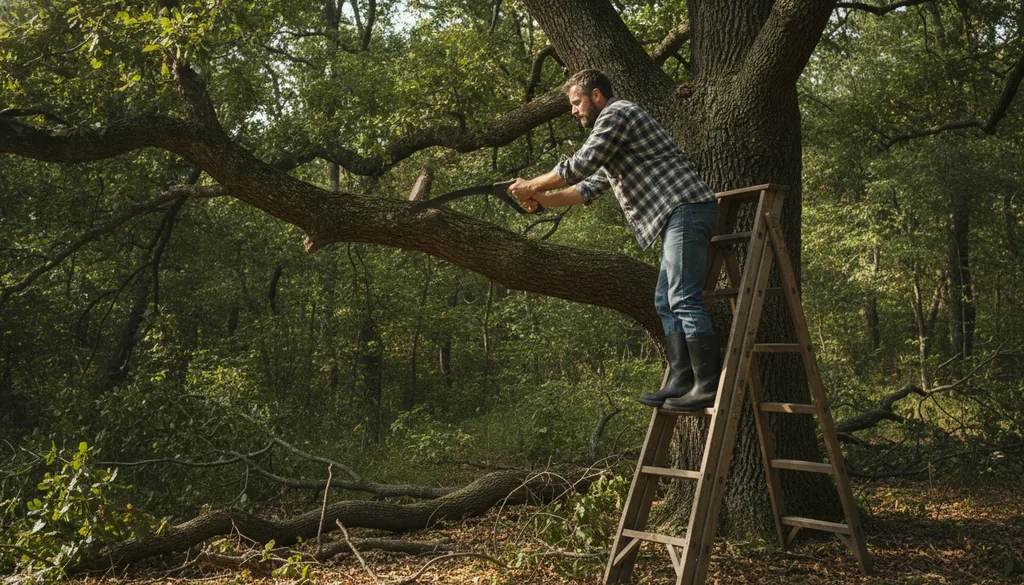
The temptation to handle a tree problem alone is understandable. A homeowner in Marietta sees an overgrown branch or a leaning trunk, borrows a saw, and figures a Saturday afternoon will save a few hundred dollars. What that calculation misses is that tree work is not carpentry with leaves on it. It is applied physics — stored energy in a bent limb, the shifting center of mass of a falling trunk, the hinge wood that decides which direction several thousand pounds of oak travels.
Aable John's Tree Service has been doing this work across Cobb County for over 40 years, and our crews have been called out to clean up more DIY jobs than we can count. The pattern is consistent: the cut goes fine right up until the moment it doesn't.
A professional crew arrives with equipment that has no equivalent in a home garage. Rigging ropes and friction devices to lower heavy sections under control rather than dropping them. Cranes for large removals in tight spaces. Bucket trucks for high-canopy access. Industrial chippers that turn a brush pile into mulch in minutes.
Every one of those tools exists to answer the same question: where does the wood go, and how fast? Without them, a homeowner is guessing. A limb that looks manageable from the ground can weigh 400 pounds and swing on the way down. The force behind it will go through a roof, a windshield, or a fence without slowing.
Safety protocol matters as much as gear. Professionals work in helmets, cut-resistant chaps, and rated harnesses. They establish and enforce a drop zone before the first cut. They plan the sequence of cuts before climbing. Our crews run these procedures daily on properties from Roswell to Powder Springs, and the reason nothing dramatic happens is precisely that all of it is rehearsed. A DIY project has none of that infrastructure — it is a high-stakes attempt with a single try and no margin.
What a homeowner reads as one dead branch is often the visible symptom of something larger. A trained certified arborist can identify internal decay, root plate damage, pest infestation, or a structural union that is going to fail — none of which announce themselves to an untrained eye. The tree gets assessed as a whole, in relation to what stands near it: the house, the driveway, the service drop, the neighbor's fence. That happens before anyone makes a cut.
The diagnosis determines the treatment. Sometimes routine tree trimming is all a tree needs. Sometimes a structurally weak but otherwise healthy tree can be preserved with cabling or bracing instead of being taken down. And when a tree is too far gone, a proper tree removal plan is built around it. Skipping this step is how homeowners cut one problematic limb and unbalance the entire crown, converting a manageable tree into a genuine hazard by the following storm.
Insider tip — the barber chair. One of the most common fatal mistakes in DIY felling is a cut sequence that lets the trunk split vertically as it goes over. The base kicks backward at high speed, straight at whoever is holding the saw. It happens in a fraction of a second and there is no reacting to it. Preventing it takes correct notch geometry and hinge wood, and those are not things to learn on a live tree in your own yard.
Getting the tree on the ground is roughly half the job. What follows is the volume problem: a medium hardwood becomes a startling pile of logs, limbs, and brush, and it has to be bucked to size and hauled somewhere. That is slow, heavy, repetitive work, and it is where most DIY projects stall out — the tree comes down on Saturday and the pile is still there in October. Professional service includes storm debris removal and land clearing; the crew chips the small material on site, hauls the logs, and rakes out.
Then there is the stump. Left in the ground it is a tripping hazard, an invitation to termites and carpenter ants working their way toward your house, and a decade-long wait for decay in Georgia clay. Stump grinding takes it below grade so the spot can be seeded or replanted.
Liability is the part nobody prices in. If a limb goes through a neighbor's roof, or a friend helping out gets hurt, that is your exposure. A licensed and insured contractor carries general liability and workers' compensation so their crew and their errors are covered by their policy. After a storm, when people search for a 24 hour tree service near me, what they actually need is the whole problem handled — hazard neutralized, debris gone, property usable again — not a half-finished job and an open claim.
Looking at a tree and wondering if it's a DIY job? Call us — we'll come look at it and tell you straight, free of charge.
(770) 218-0068Serving Marietta, Kennesaw, and Cobb County since 1985 · 24/7 emergency response
Hiring a professional tree service is not about paying someone to do something you could do yourself. It is about the assessment you cannot make, the equipment you do not own, and the insurance you do not carry. For property owners in Marietta and the surrounding communities, the right crew protects both the tree worth keeping and the house standing next to it.
If you have a tree you are unsure about, get in touch or call (770) 218-0068. Estimates are free and there is no obligation.